
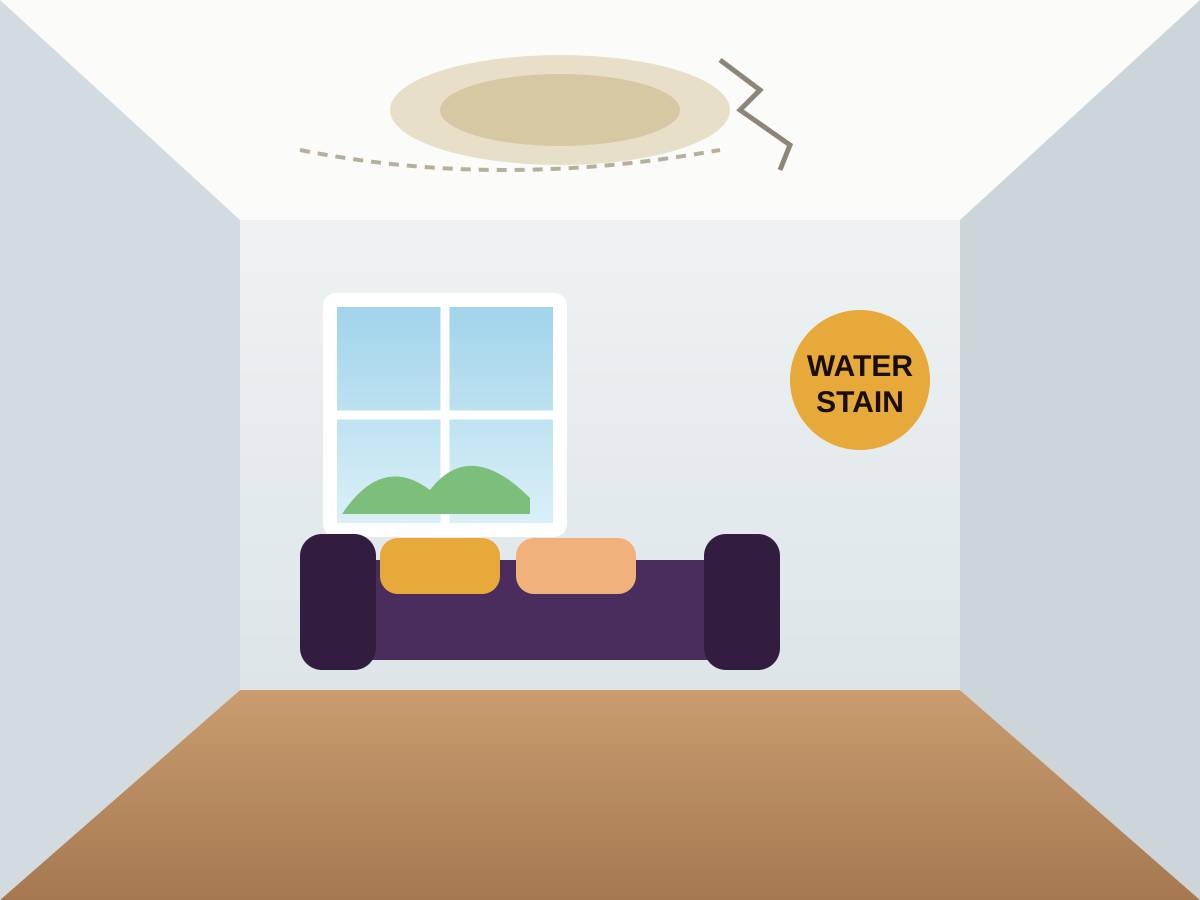
Common ceiling problems in older Tucker homes
- Leak stains under bathrooms, near chimneys and roof valleys, or below an attic air handler whose drain pan has overflowed
- Seam cracks running in straight lines where drywall tape has let go
- Nail pops: small round bumps in rows, common in houses built before drywall screws were standard
- Sagging panels that have pulled away from the joists, often after water got to them
- Flaking texture dropping bits onto furniture, usually a sign of moisture or age
- Old patches around moved light fixtures or past plumbing work that never quite blended in
If the damage is fresh
- Find and stop the water. No ceiling repair survives an active leak.
- Keep everyone out from under a bulging or soft area.
- Photograph everything before it's cleaned up, for your records and any insurance claim.
- Leave the texture alone until it has been checked, especially in a house built before the late 1980s. See testing a popcorn ceiling.
- Get a professional to assess it and plan the repair.
What turns up when the popcorn comes off
Popcorn texture was often sprayed on to save the time of finishing drywall properly, so what's underneath can be rough. Pros regularly find:
- Joints that were taped but only given one quick coat of compound
- Stains that a previous owner painted over rather than sealed
- Screw or nail heads that were never covered
- Torn face paper where scraping bit into the drywall, especially on painted texture
A good estimate expects some of this. Ask what repair work is included and how anything larger is priced.
How a ceiling repair is done
- Confirm it's dry: the source is fixed and the area has dried out.
- Cut out bad drywall back to solid material and the nearest joists.
- Fit and fasten new drywall, and re-secure any loose sheets nearby.
- Tape and finish with several coats of compound, sanded between coats.
- Seal stains with a stain-blocking primer so they don't bleed back through.
- Blend or refinish: match the surrounding surface, or refinish the whole ceiling smooth or with a new texture, then paint.
Spot repair or whole ceiling?
On a smooth ceiling, a skilled patch can disappear. On a popcorn ceiling it rarely does, because fresh texture is whiter and more uniform than 40-year-old texture. If the ceiling is already cracked in places and you've been thinking about losing the popcorn anyway, doing both at once usually means one mess instead of two.
What affects the price
- How much drywall must be cut out and replaced
- Whether another trade (roofer, plumber, HVAC) has to fix the cause first
- Ceiling height and how easy it is to reach
- Matching the existing finish versus refinishing the whole ceiling
For a price on your repair, call (678) 716‑1062 and we'll connect you with a local pro for a free estimate. The cost guide shows how repairs fit into a bigger project.
Questions worth asking
- How do you know the leak is fixed and the area is dry?
- Will this need new drywall, or can it be repaired in place?
- Can you blend the repair, or should the whole ceiling be refinished?
- What primer do you use over water stains?
Note: we don't provide emergency water mitigation. For active flooding or a major leak, contact a water-damage or plumbing service first.